NaviaCAIR Clarity for patients. Action for families.

Your medical records shouldn't need a translator.

NaviaCAIR turns visit notes into a clear Care Story — so you can walk in prepared and leave with a plan. Whether you're managing your own care or supporting someone you love.

01 · Clarity Plain-language insights from your records, every claim anchored to the source line.
02 · Control Safe Harbor–aligned redaction. You review and approve every box before analysis begins.
03 · Action A Care Story you can share with family, caregivers, or anyone on your support team.
04 · Privacy No external model training on your content. Delete a document and its derivatives in one click.
Where it started
PET/CT scan report with handwritten questions in the margins — the kind of document NaviaCAIR was built to help make sense of.
The actual scan report. The questions in the margins are ours.

"We thought we were doing everything right."

Notes. Visit summaries. Late-night searches. It still felt overwhelming.

NaviaCAIR grew out of caring for a family member through cancer — medical information scattered across portals and PDFs, dense language, and never enough time to process it before the next appointment. That experience became the first Care Story.

NaviaCAIR is led by Nathan S. — Ph.D., Computer Engineering, with a background in applied AI, identity verification, and privacy-first system design.

What we heard · ~250 responses

Asking the right questions is the hardest part.

74%

told us asking the right questions is the hardest part of a doctor's visit.

"I'm tired of re-explaining my story to every new doctor." — Survey respondent

64%
struggle staying organized across providers
58%
find it hard to explain their story to a new doctor
50%
lose track of next steps after a visit
39%
don't fully understand what the doctor said
How it works

The technology behind the clarity.

1

Redaction first

Before any AI sees your data, NaviaCAIR detects identifiers using Safe Harbor–aligned best practices. You review every box.

2

Secure processing

Private proprietary AI + third-party models with no-retention controls. Your content is never used to train external AI models. Encrypted in transit and at rest.

3

Intelligent interpretation

Jargon translated, key findings extracted, medications and follow-ups flagged — every claim anchored to its source line.

4

Actionable output

Your Care Story: how it started, what was found, current plan, next step. Share with the people who support you.

Before any analysis of your records begins, NaviaCAIR detects identifiers — names, MRNs, dates, locations — and suggests redactions. You review every box. Nothing is analyzed until you approve.

hover the dark boxes to preview

AFTER-VISIT SUMMARY · 2025-11-01 REDACTION PASS
Patient: Taylor R. Mendoza · DOB 1971-04-22
MRN 4429-880-12 · Provider Dr. Lena Chau
Visit 2025-11-01 · Reason: borderline hypertension w/ mildly elevated LDL.

FINDINGS
BP at intake: 142/91. Home log avg: 135/86.
LDL: 118 mg/dL (above goal but not urgent).
Family hx noted: mother — MI age 62.

PLAN
Lifestyle changes · recheck at 123 Oak Street Family Practice in 6 weeks.

Your documents are processed through NaviaCAIR's private AI plus third-party models configured with no-retention controls. Your content is never stored by the model provider or used to train external AI models. Our vendor agreements prohibit it.

TRANSIT · PROCESSING · STORAGE VERIFIED PER REQUEST
TLS 1.3 in transit, encrypted at rest
→ No-retention flag SET on every model call
→ Content never used to train external AI models
→ Vendor BAA on file (HIPAA-aligned)
→ Delete a document + all derivatives in one click
→ Audit log: who accessed what, and when

The AI identifies and translates complex medical jargon, extracts medications, dosages, appointments, and follow-up flags. Every claim is anchored to its source line so you can verify it.

hypermetabolic left level 4 lymph node with SUV max up to 4
a lymph node in your neck is more active than expected — worth a follow-up scan.
LDL 118 mg/dL
"bad" cholesterol is slightly above the usual goal — not urgent on its own.
BP ≥ 140/90
a blood-pressure threshold that, if crossed twice, should trigger a follow-up.

Everything organizes into one clear story: how it started, what was found, the current plan, and the next step. Personalized questions to ask. Flags worth raising. Share it with the people who support you — when you choose.

CARE STORY · TAYLOR M. 3 OF 4 COMPLETE
1 · How it started
BP log uploaded 2025-10-30 after two weeks of headaches.

2 · What was found
Above goal. Not emergent. Recheck in 6 weeks.

3 · Current plan
Lifestyle changes. Lipid follow-up still OPEN.

4 · Next step
Bring meds list. Ask 4 prepared questions. Discuss 2 flagged items.

See the full walkthrough

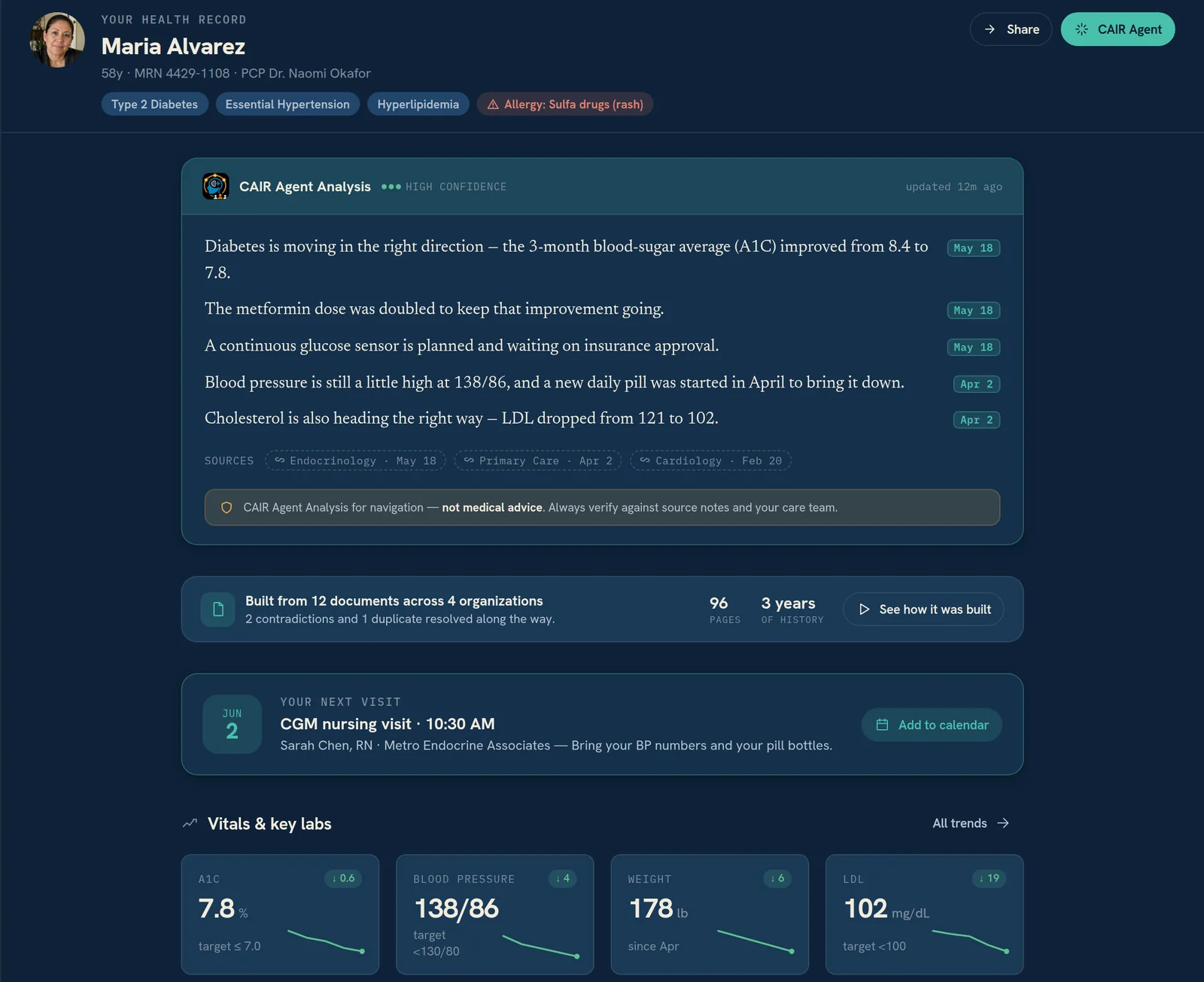
How it helps · Care Story

Every care event, with receipts.

Your Care Story Dashboard · synthetic data shown

1
How it started
Taylor uploaded a two-week BP log and questions on 2025-10-30.
2
What was found
Primary care reviewed the readings — pattern above goal but not emergent.
3
Current plan
By Dec 10, home BP improved 135/86 → 128/80. Lipid follow-up still open.
4
Next step
Lipid recheck in January. Bring meds list + 4 flagged follow-ups.
What matters most
  • Reason for visit: Borderline hypertension with mildly elevated LDL.
  • Key finding: Repeated BP ≥ 140/90 should trigger a follow-up call.
  • Also watch: Emergency threshold is BP ≥ 180/120 with symptoms.
How to prepare for your next visit
  • Bring a full list of medications, supplements, and vitamins.
  • Write down symptoms — when they started, how often, how severe.
  • Note changes since last visit: diet, activity, new stressors.
  • Review the 4 personalized questions NaviaCAIR prepared for you.

NaviaCAIR screens — synthetic patient data shown.

What people said · early pilot testing
patients & healthcare professionals · anonymous feedback

"Understanding what doctor jargon means and seeing the next steps was amazing."

"The Care Journey section was really easy to glance at and see what step I needed to focus on next."

"It clearly stated the case, the concerns, and what was most important — followed by questions that could help."

"Creating a case was simple, and the summaries were understandable."

"The format was easy to navigate — uploading documents, reviewing the summary, and seeing the next steps."

"The next steps worked clearly."

"I liked the next steps. I thought it was great."

"I'm looking forward to using it more extensively."

"Understanding what doctor jargon means and seeing the next steps was amazing."

"The Care Journey section was really easy to glance at and see what step I needed to focus on next."

"It clearly stated the case, the concerns, and what was most important — followed by questions that could help."

"Creating a case was simple, and the summaries were understandable."

"The format was easy to navigate — uploading documents, reviewing the summary, and seeing the next steps."

"The next steps worked clearly."

"I liked the next steps. I thought it was great."

"I'm looking forward to using it more extensively."

NaviaCAIR for everyone in the care circle

Find your perspective.

For patients

Your records shouldn't need a translator.

Clear summaries, plain-language findings, and the right questions for your next visit — built from your own records.

Start your Care Story →
For caregivers

Caring for someone shouldn't mean carrying it alone.

A shared Care Story for someone you love — so the whole circle stays informed and you stop having to hold it all in your head.

See it for caregivers →
For advocates

Every patient deserves an advocate who sees it all.

A Care Story per patient — organized, shareable, and ready across your whole caseload.

See it for advocates →
Try it

Try the demo. No signup.

demo.naviacair.com

Try a sample case. Watch records become a Care Story.

Want to build your Care Story for free?
Email mystory@naviacair.com.

Follow along · @naviacair on Facebook & Instagram